
NIPSCO Just Cranked Your Bill, Again. Here's What They’re Hiding.
Why your commercial energy bill went up ~30%+ this year, and what one building upgrade can do about it. A no-nonsense guide for business operators in Lake County and Porter County who are tired of feeling the drain of energy leaving the building.

- Your NIPSCO bill went up 30%+ and there’s no human you can talk to about it. No receptionist. No callback. No plan.
- 68% of commercial buildings in NWI are tenant-occupied. The tenant pays NIPSCO. The landlord owns the roof. Nobody’s fixing the problem because both think it’s the other’s job.
- Flipping a dark roof to white reflective returns 25% of your energy costs immediately. Adding insulation takes that to 45%.
- The insulation upgrade can pay for itself in under 36 months. Ask your CPA if they’d reject a 3-year ROI.
Let’s Talk About NIPSCO
Not your roof. Not your insulation. Not your HVAC. Not your thermostat. We’ll get to all that. But first: NIPSCO.
Because NIPSCO is the reason you’re angry right now. NIPSCO is the reason your profit margin is thinner than it was last year. NIPSCO is the reason you’re considering whether to raise your prices, cut your hours, or lay somebody off. Let’s not pretend the roof is the headline. The headline is your NIPSCO bill. Your roof is the answer.
You noticed it. You couldn't not notice it.
The NIPSCO bill came in and you looked at the number twice. Then you looked at it a third time. Then you put it face-down on your desk like that would help. Rolling 12 month history looks bleak.
It didn't.
Meet Vinny. He runs a taco shop on Indianapolis Boulevard in Highland. Great food, actually! Loyal regulars. A NIPSCO bill that was $2,200 last year and just popped over $4,000 this month. Not a typo. Not an anomaly. Vinny didn't change anything about his operation. He's not running extra equipment. He didn't hire a new shift. His building is the same building it was twelve months ago.
NIPSCO cranked it up. And Vinny, like thousands of business operators across Lake County and Porter County, is the one paying for it.
What Actually Happened to Your Bill
Let's be honest about something most articles won't say plainly, NIPSCO has raised your rates. Multiple times. Methodically. With full approval from State regulators who aren't particularly worried about your taco shop's payroll.
Here's what happened, in plain English.
NIPSCO filed a request with the Indiana Utility Regulatory Commission (IURC) to collect an additional $368.7 million annually from its electric customers. That's not a typo either. After a settlement process, that number came down to approximately $257 million, which is the kind of "win" that still costs you real money every single month. The average residential electric customer is looking at roughly a 16.75% increase phased in through early 2026. Commercial rates, depending on usage class, can swing harder.
Translation: commercial harder!
Before that, gas rates went up too, a $120.9 million increase approved in 2024, phased in through the beginning of 2025.
Two rate cases. Both approved. Both landing on your P&L.
Who actually pays for all this?
Try calling them about it. Go ahead. Press the button. Enjoy the hold music. NIPSCO serves approximately 500,000 electric customers across 32 counties in northern Indiana. There's rarely a human jubilantly waiting on the other end of that line who has much interest in your specific situation. You are a rate class. You are a usage tier. You are a monthly revenue unit to a company that just secured over $2 billion from the world's largest private equity firm and is spending it on infrastructure you will never personally see.
Your bill goes up. Their shareholders are fine.

The Part Nobody Is Talking About
Here's what Vinny doesn't know. Here's what most business operators in Hammond, Portage, Hobart, Merrillville, and Valparaiso don't know either,
A significant portion of what you're paying NIPSCO every month is not actually being generated inside your building.
It's escaping through your roof.
Skinny thinny insulation.
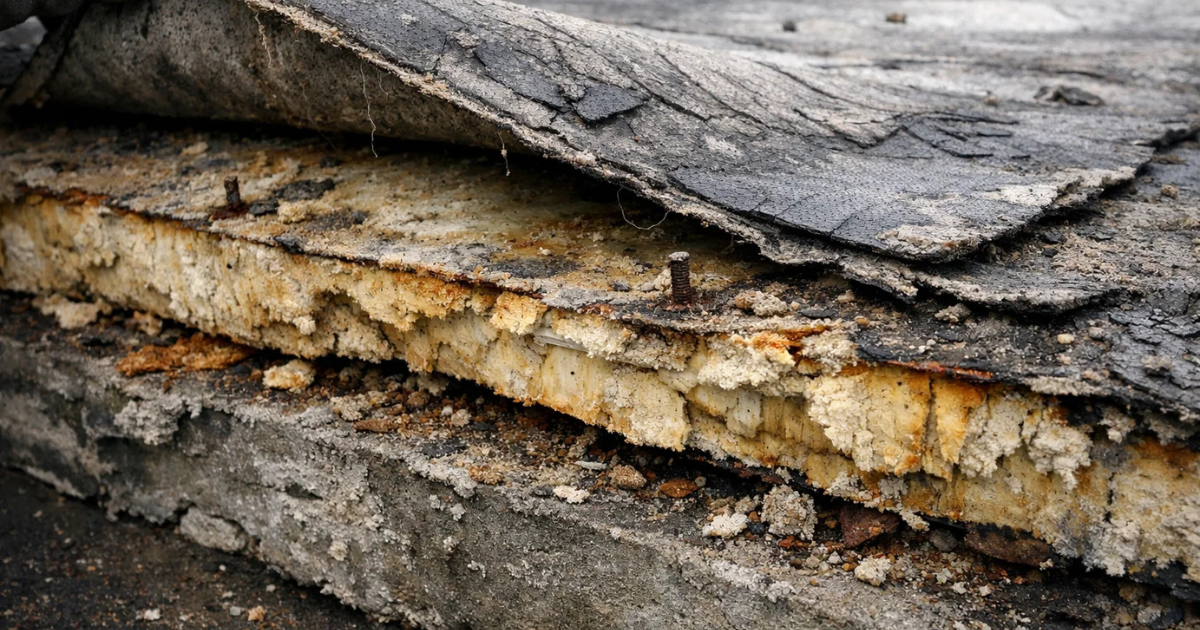
Commercial buildings in Northwest Indiana, older warehouses, strip retail, restaurant spaces, light industrial, were built in an era when energy was cheap and insulation was an afterthought. The roof decks on many of these buildings are performing at R-values so low they might as well be a screen door in January. Lake-effect moisture rolls in off Lake Michigan and parks itself over Lake County for weeks at a time. Freeze-thaw cycles crack and compress aging insulation. And that building HVAC system you're running? It's working twice as hard as it should be to heat or cool a space that is actively bleeding conditioned air into the sky.
Remember mom’s voice, “We’re not paying to cool the great outdoors!”
You are, in the most literal sense, paying NIPSCO to heat the neighborhood.
The roofing and insulation industry has a shorthand for this, thermal bridging. Heat follows the path of least resistance, and in most older commercial buildings in NWI, that path goes straight up through whatever's sitting under the membrane. Inefficient insulation board. Aged polyiso that's lost its R-value in cold weather. Bare deck in the worst cases.
NIPSCO raises its rates. Your building hemorrhages energy. Vinny’s bill goes from $2,200 to $4,000. Yet the faithful roofer comes by once a year to "check on things"?
What are they actually maintaining though? Just looking at it?
You Lease the Building. It's Still Your Problem.
Who pays the bill?
This is the part where Vinny gets stuck. And honestly, it's the most important part of this whole article.
Vinny doesn't own the building. His landlord does. The roof belongs to the landlord. So Vinny figures the roof is not his problem, and he keeps streaming auto-pay to NIPSCO.
That logic is costing Vinny a lot of tacos.
The NIPSCO bill is Vinny’s. It comes to his business. It gets paid from his operating account. It shows up on his books as overhead. When his margins tighten, Vinny cuts staff hours or raises prices or cancels that second location he was planning. He suffers real, operational consequences from a roof he doesn't own, a utility he can't negotiate with, and a landlord who's comfortable because, here's the thing, the landlord doesn't pay the energy bill.
Bill the Building Owner lives out of state. He deflects to a property manager. NIPSCO doesn't send the commercial energy bill to Bill. It taps Vinny. So Bill has exactly zero urgency to add proper roof insulation, because Bill is never cold in January in Florida.
Vinny has a bold idea.
Let’s split it.
Because here's what most tenants don't realize: a properly approached landlord, with the right numbers, the right framing, and the right ask, will often split the cost of a roof upgrade that directly reduces the tenant's energy load. Why?
- Because the upgrade adds value to the property.
- Because it extends the roof's useful life.
- Because it reduces the landlord's exposure when lease renewal time comes around and
Vinny, exhausted by his NIPSCO bills, starts looking at buildings in Portage.
Vinny has more leverage than he thinks. He just doesn't know the language yet.
What the Roof Has to Do With Any of This
There is a specific sequence of events happening inside the commercial flat roofs of Northwest Indiana right now. It goes like this:
- The roof membrane, whatever's up there; tPo (tea-po’) probably, because someone made a budget decision a decade ago, is reaching the end of its serviceable life. (tPo is our name for the old-school plastic wrap that dominated the low-bid era. Poor thing. Thin as a plastic bag. Not really his fault, he was never going to last.) Seams are separating. Therefore …
- Moisture is infiltrating the insulation layer. Wet polyiso (insulation board) is not R-anything. It's a wet sponge.
- And a wet sponge under your roof deck is actively conducting heat out of your building in Winter and into your building in Summer.
- Meanwhile, HVAC systems, rooftop units, primarily, in the Hammond-to-Valparaiso corridor, are running harder, cycling more frequently, and failing faster because they're compensating for what the building envelope cannot do.
The repair bill for the HVAC follows the roof failure by 18 to 36 months. Nobody connects the two events. Vinny thinks he needs a new A/C unit. He actually needs a roof.
Here is the simple version: a properly installed commercial roofing system, with adequate insulation board, correct drainage, and an energy-reflective skin, reduces the thermal load on the building. Less thermal load means the HVAC runs less. The HVAC running less means the NIPSCO meter slows down. The meter slowing down means Vinny’s bill looks different than it did last month.
That is not a theory. That is building science.
The specific chemistry that solves this puzzle does exist. Vinyl can be installed on commercial buildings without tearing the place apart. It carries a 300-month factory warranty, not the kind that disappears when you need it.
Superior menu options exist.
We'll get into the specifics in the next article in this series.
But here's the threshold question for right now:
Is your roof part of your NIPSCO bill?
Most operators in Hobart & Griffith didn’t know the answer.
We built a simple insulation ROI calculator.
You enter the building square footage, your current monthly energy cost, and the approximate age of the roof, and it estimates how much of your NIPSCO bill is escaping through the envelope.
It takes ninety seconds.
✉️ Enter your email below to get the calculator sent directly to you.
Email Address: ___________________________
We'll send the calculator immediately. No call. No pitch. Just the math.
[ Email address ] → [ Send Me the Real Stuff ]
The Conversation Vinny Planned
Let's say Vinny reads this article. Let's say he does the calculation. Let's say the numbers tell him what most of these buildings tell us, that somewhere between 25% and 35% of his monthly energy spend is a direct function of inadequate roof insulation and membrane performance.
Now what?
Vinny goes to Frank. Frank is the facility manager for Vinny’s landlord, the person who actually handles property decisions in the portfolio. Frank has heard from every tenant about the energy bills. Frank is tired of hearing about it. But Frank also knows that a documented, ROI-backed roof proposal that reduces tenant complaints, extends asset life, and qualifies for energy efficiency incentives under NIPSCO's commercial programs is a conversation he can take upstairs.
Frank is not the enemy. Frank is the gateway.
The way to get through Frank is not to complain about the utility bill. The way to get through Frank is to walk in with a one-page summary that shows:
- What the roof upgrade costs.
- What the tenant's annual energy reduction looks like.
- How the cost-split between landlord and tenant gets paid back through reduced overhead within a defined period.
- What the roof warranty looks like and how it changes the landlord's long-term exposure.
That's not a complaint. That's a proposal. And proposals get approved. With a side of tacos.

Enjoy a melted bowl of FAQ-ueso! (Please resist the dad jokes.)
NIPSCO Bills and Commercial Roofing in NWI
Q: Why did my NIPSCO commercial energy bill go up so much this year?
A: NIPSCO received IURC approval for a series of rate increases phased in through 2026, totaling roughly $257 million annually in new revenue from electric customers alone. Commercial operators in Lake County and Porter County are experiencing these increases alongside prior gas rate adjustments approved in 2024. The increases are structural, they will not reverse when the weather changes.
Q: Can improving my commercial roof actually reduce my NIPSCO bill?
A: Yes. A significant portion of commercial heating and cooling loss in NWI buildings occurs through aged or underperforming roof insulation. Upgrading the insulation layer and membrane system reduces the thermal load on HVAC equipment, which directly reduces the kilowatt-hours and therms being billed. Energy savings of 15% to 30% on conditioned-space loads are documented in comparable building upgrades in the region.
Q: I lease my space, can I actually get my landlord to do something about the roof?
A: More often than most tenants expect, yes. When approached with documented ROI, energy cost reduction, asset life extension, NIPSCO commercial efficiency program incentives, landlords and property managers have real financial reasons to act. The key is framing it as a property investment, not a tenant complaint. We can help you structure that conversation.
Q: What is the right type of roofing system for energy efficiency on a commercial flat roof in NWI?
A: This depends on the vapor barrier underneath, decking, current membrane condition, and building traffic, but systems that combine closed-cell or high-performance polyiso insulation boards with a reflective or properly sealed membrane consistently outperform the aging tPo and single-ply systems by 30%+.
A roof assessment identifies the specific gap between what's there and what should be there.
Q: Does NIPSCO offer any programs to offset commercial energy efficiency upgrades?
A: NIPSCO's commercial custom incentive programs provide financial incentives for qualifying energy-efficiency projects, including building envelope improvements. The amounts vary by project and usage class. A qualified assessment can identify whether a specific roof upgrade qualifies and what documentation is required.
Q: How do I know if my roof is contributing to my energy bill?
A: The fastest answer is the insulation ROI calculator linked in this article, it estimates based on building age, size, and current energy spend. The more complete answer comes from a thermal performance assessment of the roof itself. Both start with a single piece of information: the subject property address.
Get calculator below. 👇
One More Thing Before You Go
Vinny is real. The taco shop on Indianapolis Boulevard is real. The jump from $2,200 to $4,000 is real. Go talk to him. He loves people.
And Vinny is not alone. Across Hammond, Gary, Portage, Valparaiso, and every strip center and warehouse corridor between them, the same math is playing out on the same old buildings with the same underperforming roofs. NIPSCO is going to keep doing what NIPSCO does. The rate cases are going to keep coming. The regulatory commission is going to keep approving them, because the infrastructure argument is real, even if the outcome is painful.
The question is not whether your energy costs go up. They already have. The question is whether your building is helping NIPSCO collect more from you than it should.
One building upgrade. One conversation with Frank. One ninety-second calculator.
That's where this starts.

✉️ Get the NWI Commercial Insulation ROI Calculator — FREE
Email Address: ___________________________
Enter your email and we'll send it directly. No sales call. No appointment required. Just the math you need to have the right conversation.
[ Email address ] → [ Send Me the Real Stuff ]
Pristine Industrial Roofing — Serving commercial and industrial property owners across Lake County and Porter County.
Liquid-applied Conklin coating systems. FLEXION vinyl membranes. Proactive maintenance programs.
Valparaiso | Hammond | Portage | Merrillville | Hobart | Gary
Next in this series: Your Landlord’s Been “Fixing the Roof” for a Decade. You’re Still Paying NIPSCO.
Read other blog:



We Love Conversations
 SoHelpful@PristineIndustrialRoofing.com