
The Philippines Has Scheduled Brownouts. They're Coming Here Next.
What NWI business owners can learn from countries that already lost the energy battle. Look across the ocean. See what they're doing over there. Now ask yourself: do you have the spirit of ambition?

- The Philippines publishes a brownout calendar. Scheduled outages. Four to five hours or more. On the website. Normal life.
- The largest grid operator in the U.S. has already warned it's connecting data centers it doesn't have capacity to reliably serve. The word "blackouts" appeared in the regulatory filing.
- China controls over 80% of global solar manufacturing and is accelerating. The U.S. is importing tariff drama.
- You can generate your own power. On your building. Right now. Nobody can take that away from you.
The Philippines Has a Brownout Schedule. Read That Again.
Most Americans have never heard of a brownout schedule. The concept doesn't compute. We expect the lights to be on. Always. Without thinking about it.
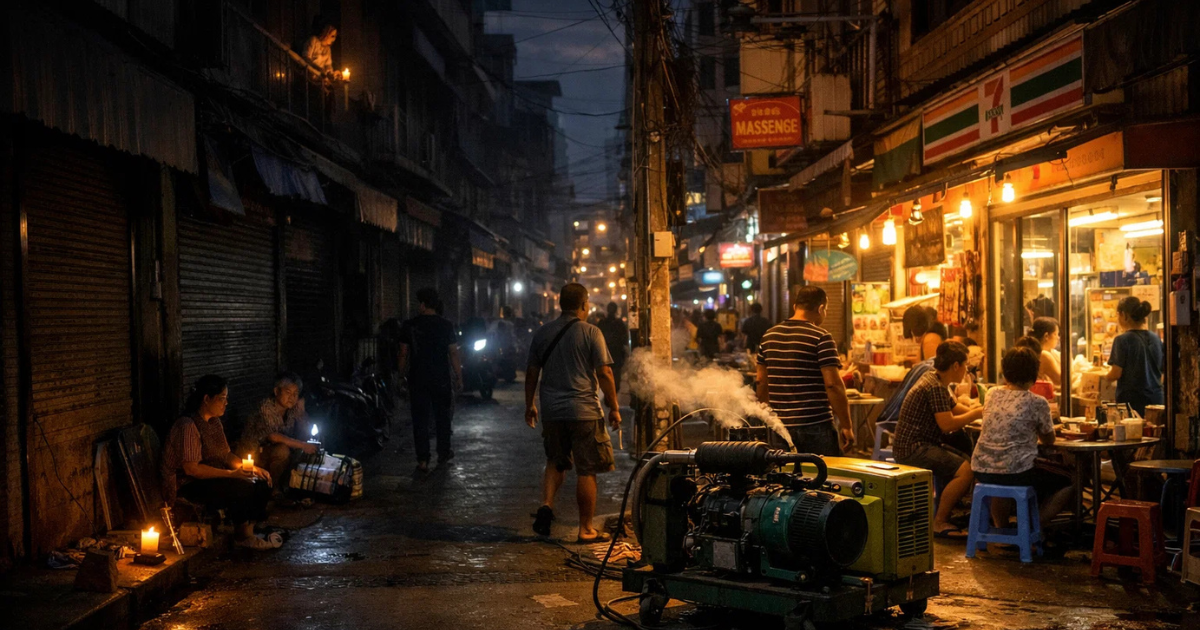
In the Philippines, that assumption is gone. Rotational brownouts, scheduled power interruptions where electricity is deliberately cut to specific districts on a rotating basis, are routine. The utility posts the schedule publicly. Residents plan around it. Small businesses run generators. Every household in a brownout-prone area has a survival strategy for the interruption that is coming whether they like it or not.
Most scheduled brownouts last four to five hours. Unplanned ones vary. Major repairs or severe weather can extend outages to twelve hours or more in provincial regions with limited backup lines. In May 2024, the Philippine power grid spent 21 of 30 days under red or yellow grid alerts. On June 1 of that year, a red alert was declared across the Luzon grid and rotational blackouts hit from 10am to 10pm, twelve hours of managed rationing across the country's most populated island.
The cause is not a mystery. The cause is exactly what is now beginning to happen in the United States, demand grew faster than infrastructure. Generation couldn't keep up. The grid got fragile. Rationing became policy.
The Philippines did not choose this. It arrived. And the people who adapted, who installed generators, who bought battery packs, who built systems to keep running when the lights went out, those people didn't get credit for being clever. They just didn't stop.
Now look at what is happening here.
The U.S. Grid Is Already Cracking Under Data Center Demand
PJM Interconnection covers thirteen states and the District of Columbia. It serves 67 million people. It is the largest grid operator in the United States. And it has formally acknowledged, in regulatory filings, that the data centers queuing up to connect to its grid represent demand it cannot reliably meet.
The independent monitor for PJM filed what one publication called a "regulatory grenade" with the Federal Energy Regulatory Commission, asking the federal government to pause new large data center interconnections until PJM can guarantee reliable service. The filing's logic was blunt, if PJM has an obligation to provide reliable service, is it just and reasonable to add new loads it cannot serve reliably?
Data center load alone increased PJM's annual energy-commitment auction revenues by more than $7.2 billion — 82% — over the prior year. Across seven of the thirteen states where PJM operates, consumers paid $4.4 billion in 2024 just to fund transmission upgrades necessary to accommodate data centers. NRDC estimates PJM consumers will pay another $163 billion through 2033 as new data centers exceed available power supply. That translates to roughly $70 more per month for the average household.
Meanwhile, the North American Electric Reliability Corporation reported that electricity demand is growing 2.5% faster than last year, a rate that in recent years was 1% or less, with data centers driving a significant chunk of that growth. The Department of Energy has warned that blackouts could increase by 100 times by 2030 if the U.S. continues to retire reliable power sources without adding sufficient firm capacity in return.
Now, Indiana is not part of PJM. NIPSCO operates in its own territory. But the dynamic is identical and the numbers are local: a Hammond city council member noted that just a handful of hyperscale data centers coming to Northern Indiana would, by 2030, use more electricity than all Indiana residential customers combined. NIPSCO is building gas plants to handle it. The regulatory structure, GenCo, rate cases, new infrastructure, is already moving. Your bill is already among the highest in the state.
The Philippines printed the brownout calendar because the gap between supply and demand became impossible to hide. The U.S. is running the same play in slow motion. The only open question is how long the slow motion lasts.

Meanwhile, China Made a Decision
While American politicians spend years debating which energy source deserves a tax credit and which one deserves a tariff, China made a decision about a decade ago and has not deviated from it.
China has invested over $50 billion in new solar manufacturing capacity since 2011, ten times more than Europe. Its share of global solar panel manufacturing now exceeds 80% at every stage of the supply chain: polysilicon, ingots, wafers, cells, modules. The top 25 solar manufacturers globally grew their combined shipments from 172 GW in 2021 to 687 GW by 2024, a more than 300% increase in four years.
Global solar module manufacturing capacity is on track to reach 1.8 terawatts by the end of 2025. That is roughly triple the total solar installed globally in 2024. China is building manufacturing capacity far in excess of current global demand, on purpose, to drive costs down and lock in its position as the world's dominant energy equipment supplier.
The result of all that investment: solar costs have fallen more than 80% over the last decade. The panels that would have cost $3,000 per kilowatt to install in 2015 now cost closer to $1,000 per kilowatt in most markets. In some Asian markets, it's $500 to $700. The technology that generates electricity from sunlight, for free, every day, for 25 to 30 years, has become the most affordable electricity generation technology in many parts of the world.
China is not doing this out of environmental virtue. They are doing it because energy self-sufficiency is geopolitical power. When you generate your own energy, you are not hostage to fuel prices, supply disruptions, or foreign politics. When your entire country generates its own energy, you are not hostage to anyone.
Scale that logic down from geopolitics to a commercial building on a block in Northwest Indiana. The principle is identical. You cannot control what NIPSCO charges. You cannot control what the IURC approves. You cannot control how many data centers Amazon builds near Hobart. You can control what happens on your roof.

✉️ We're building a solar + battery assessment program for NWI commercial and multifamily buildings. Real numbers. Your building. No pressure.
Subject Property Address: ___________________________
Drop your email and we'll reach out when the program launches. First buildings in get the most attention.
[ Email address ] → [ Send Me the Real Stuff ]
Do You Have the Spirit of Ambition?
Here is the actual question.
Every article in this series has been making the same argument in different ways: the grid is not your ally. It is infrastructure built by a monopoly, regulated by a commission that moves slowly, increasingly strained by industrial demand you have no vote in, and priced at the highest rate in the state. The people who are going to be okay are not the ones who waited for the utility to fix it. They are the ones who reduced their dependence before it became urgent.
The insulation was step one. You made your building tighter. Your load dropped. Good.
Solar plus battery storage is step two. Here is what it looks like in plain terms.
Panels go on your roof. During daylight hours, your building runs on what the panels produce. Surplus goes into a battery instead of back to NIPSCO's grid — because Indiana's buyback rate is so low that donating power to NIPSCO and buying it back later is a losing transaction. At night, your building draws from the battery. NIPSCO's meter barely moves.
You are still connected to the grid. You are not going off-grid. When the battery depletes and the sun isn't up, NIPSCO is your backup. But across a year, the fraction of your energy that comes from the utility, and is therefore subject to rate increases, regulatory decisions, and whatever the data center buildout does to regional demand, drops significantly. Maybe 40%. Maybe 60%. Depends on your roof, your load, your battery size.
That fraction you eliminate is permanently outside the rate case. It doesn't matter what NIPSCO charges per kilowatt-hour for energy you never buy from them.
This is not complicated technology. It is not experimental. Solar panels have a 25- to 30-year functional lifespan. Battery storage is commercially proven. The system sizing is a math problem, and the math has gotten much more favorable as hardware costs have dropped. The federal 30% solar tax credit expired at the end of 2025, which removes one incentive, but Indiana still offers a property tax exemption on the added value solar brings to your building, and a sales tax exemption on the equipment itself. The economics are tighter than they were a year ago. They are still workable for most commercial buildings with decent rooftop exposure.
The businesses that will look back on 2025 as a turning point are the ones that ran the numbers this year instead of watching the situation develop from the sidelines.
Things You're Probably Already Wondering
Q: Does solar actually work in Indiana? It's not exactly Arizona.
A. Yes. Indiana ranks 8th in the U.S. for solar production. Panels respond to light, not heat, they generate on cloudy days, just at reduced output. The math is based on your annual average, not your best July. Winter months produce less; summer months produce more. Across a full year, the numbers work for most commercial rooftops in NWI.
Q: Do I have to go off-grid for this to be worth it?
A: No. You stay connected to NIPSCO as backup. The goal is to reduce how much you buy from them, not eliminate the relationship entirely. Even cutting your grid dependence by 40–60% meaningfully changes your exposure to rate increases.
Q: What happens when the battery runs out?
A: NIPSCO kicks in automatically. Your building doesn't notice. You just draw from the grid the same way you do now, until the sun comes back up and the battery recharges.
Q: Didn't the federal solar tax credit just expire?
A: Yes, the 30% federal ITC expired December 31, 2025 under the One Big Beautiful Bill. That changes the math somewhat. Indiana still offers a property tax exemption on solar-added home value and a sales tax exemption on equipment. The economics are tighter than a year ago. For commercial buildings with strong sun exposure and high NIPSCO bills, they still pencil out, but the calculation is now building-specific, which is exactly why we run the numbers before recommending anything.
Q: How long does a commercial solar + battery system actually last?
A: Solar panels carry 25 to 30 year performance warranties. Battery systems typically run 10–15 years before capacity degrades meaningfully, at which point they can be replaced without touching the panels. The infrastructure you put on your roof this year is still working when your building's next two leases have expired.
Q: What's the payback period?
A: It depends entirely on your roof, your load profile, your current NIPSCO rate, and system sizing. For commercial buildings in NWI with typical consumption patterns, payback periods have historically ranged from 6 to 10 years on a 25 to 30 year asset. That range has shifted somewhat with the ITC expiration. Running your actual numbers is the only honest way to know, which is what the assessment is for.
Q: Is this just for building owners, or can tenants do anything?
A: Building owners have the most leverage, they control the roof and the electrical infrastructure. Tenants can advocate with their landlords and can absolutely influence the conversation. If you're a tenant in a commercial or multifamily building and want to bring this to your building owner, we can help with that conversation.
Q: Why haven't more NWI buildings done this already?
A: Indiana's hostile net metering policy killed a lot of the early momentum. When people heard "you can't sell back to the grid at a fair rate," many concluded solar didn't make sense and stopped investigating. The battery model changes that conclusion, but the updated framing hasn't fully penetrated the market yet. That gap is exactly what this program is designed to close.
The Beta Test
We are building an energy independence assessment program for NWI commercial and multifamily buildings. Not a national solar company sending a commission-based rep with a financing brochure. A local program, built for NIPSCO rates, NWI buildings, and the specific grid dynamics that have been the subject of this entire series.
The assessment covers your actual load profile, twelve months of consumption, peak demand hours, seasonal patterns. Your roof, orientation, shading, structural capacity, square footage. Your numbers, payback period, annual savings, system sizing calculated against your specific usage and current NIPSCO rate. Battery sizing. And what energy independence actually looks like for your building: not the optimistic version, the real one with real tradeoffs.
This program is in development. The first buildings through it get the most attention, direct involvement from the people who built it, not a junior rep working through a checklist.
The sun rises over Northwest Indiana every morning. It hits your roof whether you catch it or not. China decided to catch it ten years ago and now supplies 80% of the planet's solar panels. The Philippines decided not to prepare, and now they publish a brownout calendar.
You get to decide which story you're in.
Power shortfalls and rolling outages could happen in the next few years in regions where data center demand outstrips supply. That's not a fringe prediction. That's the grid's own reliability monitors, on the record, in regulatory filings.
You do not have to be in the dark when it happens.

✉️ Get the calculator out. Let us run the numbers. Let's see what works for your building.
Subject Property Address: ___________________________
No pitch. No calls. No pressure.
[ Email address ] → [ Send Me the Real Stuff ]
Pristine Industrial Roofing — Serving commercial and industrial property owners across Lake County and Porter County.
Liquid-applied Conklin coating systems. FLEXION vinyl membranes. Proactive maintenance programs.
Valparaiso | Hammond | Portage | Merrillville | Hobart | Gary
We’re almost at the finish line. This is Article 9 of 10 in our NIPSCO series. Don't go. Finish reading.
Read Article 1 here, NIPSCO Just Cranked Your Bill, Again. Here's What They’re Hiding.
Article 2, Your Landlord's Been "Fixing the Roof" for a Decade. You're Still Paying NIPSCO.
Article 3, Dark Roof? That's 25% of Your NIPSCO Bill Right There.
Article 4, NIPSCO and the Indiana Statehouse Had an Affair. You're Paying for the Hotel Room.
Article 5, Your NIPSCO Bill Went Up 30%. Insulation Drops It 45%. Do the Math.
Article 6, Vinny's Taco Shop Just Got a $4,000 NIPSCO Bill. Here's What He Did About It.
Article 7, Data Centers Are Eating NWI's Grid. Guess Who's Paying for It.
Article 8, Stop Thinking the Grid Will Reward You. NIPSCO Is Not Your Battery.
Finally, next and the last in the series: Have You Been to NIPSCO Headquarters? Good Luck Getting In.
Read other blog:

We Love Conversations
 SoHelpful@PristineIndustrialRoofing.com